
Why “Wrapped-Style” Campaigns Work

If you have seen people share their listening summaries from Spotify, or activity snapshots from platforms like LinkedIn, YouTube Music, or Uber, you have already seen one of the most effective forms of modern marketing.
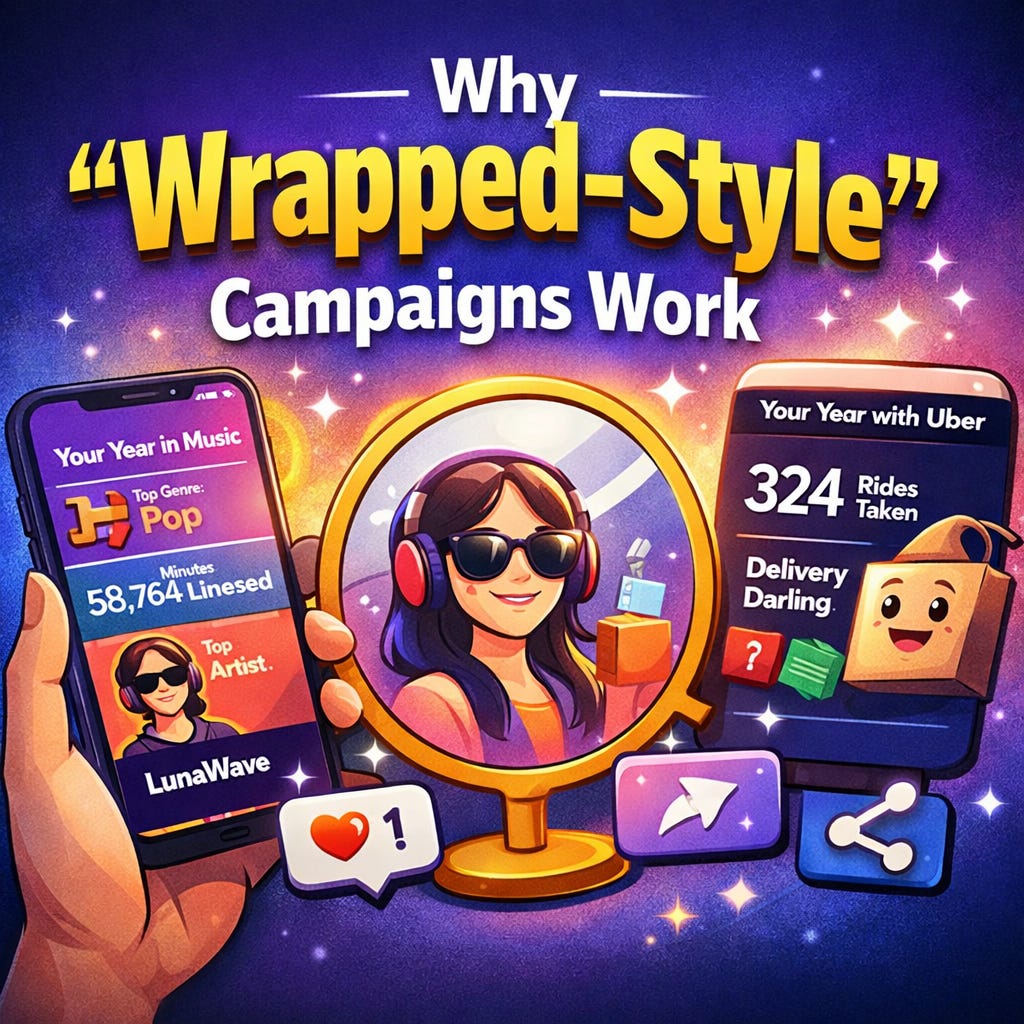
These campaigns do not fit into traditional categories.
They are not performance marketing.
They are not social media marketing.
They are not SEO.
They belong to a rarer category called data-driven, product-led marketing.
The idea is simple. People are interested in themselves.
When a product says, “Here is what you did,” curiosity becomes unavoidable. Almost nobody ignores it.
But the real impact happens after the click.
The user is not shown raw data.
They are shown a story about themselves.
If the result is flattering, funny, or accurate, people share it. Not because they are asked to, but because it represents them.
At that point, the user becomes the marketing channel.
There are no incentives, no influencers, and no paid amplification. The product creates something worth sharing, and distribution happens naturally.
This works only when three things come together.
Meaningful first-party data.
Clear interpretation of that data.
Built-in shareability.
Miss any one of these, and the campaign falls apart.
The takeaway is simple.
Great marketing does not always look like marketing. When a product helps users see themselves more clearly, marketing becomes a side effect.
That is the difference between promoting a brand and designing something people want to talk about.